
FUN STUFF HAS INFORMATION ABOUT LONDON AND ROME FOR FAMILIES. VIDEOS, PUPPET SHOWS, TOP TIPS ABOUT ACTIVITIES, PLACES TO VISIT AND WHERE TO EAT IN LONDON AND ROME WITH CHILDREN.

Gastone's History of Rome - The Early Kings of Ancient Rome
The Early Kings of Ancient Rome
Hi all,
We have another History of Rome video from Gastone – this time about the early Kings… you can see why those Romans went for a Republic after a while!
Do watch, like and follow.
Stay safe and see you soon
Gastone and Sarah xxx

Sarah's Art History - Masaccio and the Early Renaissance
Today we are looking at Masaccio and the Early Renaissance.
Sarah’s Art History - Masaccio and the Early Renaissance
Hi there,
How are you all doing in these strange times? Well, here is your five minutes of distraction…
Today we are looking at Masaccio’s Virgin and Child, 1426 (in the National Gallery) Look it up at www.nationalgallery.org.uk and click on the ‘-‘ so you can see the whole image on your screen.
Questions:
1. What is the baby doing?
2. What position is his hand in?
3. How many angels are there and what are they doing?
Then watch the video!

Activities:
1. As you know Massaccio was based in Florence, the hotbed of artistic innovation during the Renaissance, so why not visit Florence virtually and do a bit of research on it? First stop – the Uffizi Gallery for art,or more generally the Renaissance (you could check out these pages: https://bit.ly/2Xgjcii or https://bit.ly/2RimFcj )!
2. Find out more about Masaccio – this is a fabulous website: https://bit.ly/2JGC1Di
3. Draw your own perspectival throne/cube/anything. Have a look online or check this out to copy: https://bit.ly/3bPX5Dk or https://bit.ly/2JKqIKw
4. Make a frame of any drawings you make with ancient Roman patterns and motifs – you can get some ideas here: https://bit.ly/3e1vb9i (if you want to be really ambitious then you can make them mosaics – cuts out little squares of coloured paper and stick them down). Then fill it with your own painting.
5. This is what the whole altarpiece would have looked like (some bits are missing) https://bit.ly/3bWZKvc . Make your own with your favourite story - choose a story, draw pictures of all the key moments of the story, then put them together like Masaccio’s altarpiece.
Our next painting will be the lovely Uccello’s The Battle of San Romano, 1438-40 in the National Gallery.
Your questions: 1. What is this a picture of and which side is winning? 2. How many people are dead? 2. The helmets are pretty fancy - which is your favourite?
Thanks for watching. Do like, follow, share! See you next time and stay safe.
Sxxx

Gastone’s Rome – Romulus and Remus and the Foundation of Rome
Gastone’s Rome – Romulus and Remus and the Foundation of Rome
Today Gastone is telling us stories about the foundation of Ancient Rome in his beautiful garden in the Campagna Romana, a perfect location for ancient Roman discussions!

We have more on the story of Romulus and Remus and the foundation of Rome from last week – we’ll hear about the mysterious Vestal Virgins, Mars, the fearsome God of War as well as kidnappers, robbers and murderers – who said founding the greatest Empire the world has ever known (feel free to argue this) was going to be a peaceful affair?!
(this also calls me (Sarah) to do a painting sometime soon of the Rape of the Sabine Women in the National Gallery by Rubens… that’s to come!)
Have a lovely Saturday everyone, and stay safe xxx

Gastone's Ancient Rome
Gastone Ciacci tells us all about ancient Rome!
I am soooo excited to announce that my fab dad Gastone Ciacci, real Roman and tour guide extraordinaire, is also going to do a series of little films about ROME!!!!

Here is his introduction. Do like, follow and share! We look forward to seeing you next time!
Stay safe xxx

Sarah's Art History - Wilton Diptych and International Gothic
Hi there!
How are you all doing? In this video we’re talking about The Wilton Diptych, from the late 1300s, you can find it at the National Gallery.
Before you watch the video, your three questions are:
1. How many angels are there with wings?
2. How many Kings with Crowns?
3. Can you find the mushrooms ?

…and here are some activities you might want to do afterwards:
• Make a drawing of the painting.
• Explore early English Kings - Look up Richard II and find out about his rather challenging life, and sad ending, and then there is also Edward the Confessor and King Edmund. Draw a picture of your favourite bit of their life. Or make up a play about them!
• Decide what symbol you would have if you were in a painting, and what animal would you choose for your badge (it is a white hart/deer in the painting).
Next time: We will be looking at Masaccio’s Virgin and Child, 1426 (in the National Gallery) Look it up at www.nationalgallery.org.uk and click on the ‘-‘ so you can see the whole image on your screen.
Questions:
1. What is the baby doing?
2. What position is his hand in?
How many angels are there and what are they doing?
Thanks for watching. Do like, follow, share! See you next time and stay safe.
Sarah xxx

1. Sarah's Art History - Byzantine and Margarito

We’re talking about Margarito of Arezzo, The Virgin and Child Enthroned with Scenes from the Lives of the Saints, 1260s so watch the video and here are some activities you might want to do….
Activities
• Read the information on the National Gallery website about this painting. Choose 1 most interesting fact each. Let me know!
• Choose your favourite tiny detail that you think other people might not notice.
• If you want to know about art in the west you need to know the biblical stories, they were the main subject matter of painting for many years. So use this to explore the birth of Christ (nativity) and generally Christ’s life – this will be sooooo useful for understanding paintings. If you want to broaden this out, compare his life and teachings with the other major religious teachers – the Old Testament Jewish figures, Buddha, Mohammed, etc (this could be art of a longer project).
• Or you could focus on researching the Virgin Mary, or the saints – Benedict has some giggly bits for teenagers, St Margaret is pretty interesting too.
• Look up the Saints in this painting and find out what they are saints of (sometimes surprising things!). Saints always have a symbol (s) that they hold – what are the symbols of the Saints in this painting? Can you draw your own saints with their symbols? If you want further reading the historic Golden Legend by Jacopo de Voragine has all the apocryphal stories of the lives of the saints… it’s on my shelf as yet unread!
• Prepare a little play from the life of Christ. Kids choose. Any scene, any how. Wear costumes! Use props! Send me a video!
• Design a different throne for Mary and Jesus to sit on. Send me a picture!
Next time:
We will be looking at The Wilton Dyptich, late 1300s (we don’t know who painted it), also at the National Gallery. Look it up at www.nationalgallery.org.uk (copy the painting info and national gallery in google and it should be the first link) but also find a good image of it in google/bing search to look at with me online.
Questions:
1. How many angels are there with wings?
2. How many Kings with Crowns?
3. Can you find the mushrooms (close looking please!)
Thanks for watching. Do like, follow, share! And Happy Mother’s Day and see you next time!
Sxxx
Sarah's Art History - Introduction and Painting no. 1
Hi there, welcome to first of Sarah’s Art History.
Where we’ll go through the history of art painting by painting, I’ll give you some activities and three questions about the next painting we are going to look at… so first up –
Copy and paste this into google: Margarito of Arezzo The Virgin and Child Enthroned National Gallery
And it should be the first link (if not find it through the National Gallery website – www.nationalgallery.org.uk, click on the magnifying glass, click on paintings, type in ‘margarito of arezzo’, click on painting)
Find the little box lower left with the painting in small and click on the – so you can see the whole painting. And answer these questions for when we meet up again soon.
Questions before we begin!
Where is the mother and baby?
How many boxes on either side? (look at the pictures in them. Which is your favourite?)
Can you find the dragon? How many heads has he got?
Spread the word, follow on Instagram/Facebook/Twitter and look for Tours For My Kids!
See you soon to learn about the painting!
Sarah xxx


Surviving Tours with Kids in the Heat
Surviving Tours in the Heat with Kids
We are melting here in London and Rome so I thought I would write a quick note on surviving guided tours with kids – some ideas for you!
1. Wear light clothes that cover your kids up, and a hat, and lots of sunscreen. I know you know this already, but of course worth mentioning. Longer sleeved clothes and longer shorts mean that you won’t be worrying as much about sunburn, a big brimmed hat will keep them cooler and keep the sun off, and make sure you bring along your bottle of sunscreen. Comfy, airy shoes also help. Bring a change of clothes as well – London has some great fountains you can run through - Somerset House, the Southbank, Leicester Square which might be nice to cool down in; and Rome has all the water fountains so you can just fill up your water bottle and pour it over your kids! (No jumping in the fountains in Rome though – you will be fined!)

San Cresino in Rome is one of my very favourite places to get ice cream in Rome. GO!!!!!
2. Bring lots of liquid and snacks. You will all have your own way of doing things, but when it is crazy hot my healthy eating routine with my daughter goes out of the window. Of course I bring lots and lots of water, but I also bring juice, in part for bribery and in part to ensure that she does drink liquid. I bring sweet things, salty things, treat things (bribery again) and fruit. At the end of the day generally the fruit is still in her lunch box – but we got through the day!!!
3. Remind your guide that you need shade. Guides love talking about the places you are visiting, and sometimes we forget about the sun so don’t be afraid to say that you need some shade. They will accommodate you!
4. Tell your guide you need a snack break. Take 10 minutes in a café to rehydrate, sit down and relax. Or maybe buy an ice-cream and sit in the shade of a tree for a while. I know that you might feel like you want to just keep on going, but your guide can tell you stories about London or Rome or history, or just find out a bit more about you and your family. It is not time wasted and it will give you all a little bit more energy.

There are some beautiful and historic little corners where you can chill out in the shade for a bit.
5. Do remind your guide that your kids might be grumpy/tired/not sleeping well because it is so hot (on top of that they may be jet-lagged too, and in a strange, new place – it is a lot to deal with! There may be tantrums (and boy can toddler heat induced tantrums be spectacular!). Guides are sensitive souls and might think that the kids just don’t like them – but when it is hot it is so difficult for little ones and it is good to remind guides of that. Tell them you might need to be a bit flexible and take some time out, or have an impromptu nap, or deal with the tantrum to beat all tantrums, whatever. Remember guides are there for you, so tell them what is going on and your guide will do their best to accommodate it.6
6. Bring a buggy (if your kids are buggy age). I am obsessed with the buggy. Although my daughter could walk it is basically a portable bed, so when a nap is needed then she can nap. Most places in London are buggy accessible (Rome is a little more difficult so do speak to us about this). Another option is a baby/toddler carrier. Have a think about it, it might help!
7. On the Underground - in both London and Rome it is even hotter on the underground than outside. Try and avoid rush hour so it is not as packed. Strip off if you can. and make sure you have water so you don’t faint. Plan your journey in advance, so you know what you are doing and that you don’t get a train in the wrong direction - not what you need when it is hot! But you will just have to suffer it so prepare to suffer!

Strip off on the tube, bring water and avoid rush hour!
8. Well, us grown-ups have trouble concentrating in the heat, so imagine how hard it must be for a tired, sweltering toddler. So, if all else fails, get the bubba in the buggy/baby carrier and crack out the TV on your mobile. Yesterday I was on a delayed, packed train with no air conditioning. We were sweltering. My daughter was tired and hot, so out came the TV. There is a time and a place and if your little ones cannot cope then just do it. Even on a tour! Invest in some earphones so they don’t disturb anyone else, and then you get to enjoy the tour and the little one has some down time and doesn’t have a melt-down (you may not be able to do this in all sites, but walking from site to site might give your toddler the break they need to recharge).
9. Think about changing the order of the day – do you have a site visit in the morning and walking tour in the afternoon? Consider (if it is possible) doing the walking tour early and the site visit later on – that way you don’t have to walk outside in the heat of the day. Our guides are trained to be flexible – so talk to them about it.

When there is not a cloud in the sky offering you some shade - think about heading inside instead of a walking tour.
10. Less is more. If it is crazy hot then consider cutting something and spend longer in a café, or sitting in a park, or similar. Kids (and adults) need downtime and if you have too much to cover on a hot day then cut it down and at least make sure you enjoy one or two things rather than be stressed and hot and bothered all day. Ask your guide what should not be missed and how best to plan the day in the heat… you will have a great day with beautiful memories!
All our guides are professional and trained and therefore are flexible and able to change things (within reason of course) to ensure clients of all ages have the best possible time. So, good luck! Enjoy! And I hope you survive the hot weather!

Kid Friendly Museums in London: Things to do in London with children
So, are you wondering what to do in London with kids? This blog is going to look at a few different types of museums in London that you can visit with your kids.
So, are you wondering what to do in London with kids? This blog is going to look at a few museums in London that you can visit with your kids. I have tried to choose a variety that are all child-friendly, so you can include the educational, as well as culture, fun, outdoor spaces, interactive elements, good cafes, and there are some options here for those of you who might have visited London before or those who might be on a budget - one of the great things about London is that so many of our museums and galleries are free to get in (all of the ones here are free for the permanent collections) and let’s face it, kids are expensive!


Art for Kids at the National Gallery
One of my favourites (actually – they are all my favourites!)! It is free entry (although donations welcome) to this amazing collection of paintings, masterpieces of Western Art, you can find Leonardo, Van Gogh, Rembrandt and Caravaggio, amongst others. It would be both an educational and cultural visit and although it doesn’t really have much that is interactive, you can set your own challenges for your kids. I like to choose something that pops up a lot in paintings, but not all the time, like animals and then you can explore the gallery finding all the animals. Other themes I have chosen include “Ears and Elbows”, or you could try finding the best hat! You could also buy some postcards of the highlights beforehand and send your kids off to find them (this does involve some prep – check out the National Gallery website to see what is on display), then when they get home you can get them to hang them up and make their own gallery, like in the picture. The outdoor space is the huge, beautiful and largely pedestrian Trafalgar Square, so if you need to let off steam or take a break you can pop out for a run around or check out the sometimes good, sometimes cheesy street performers outside the gallery. There are also cafes around the Square (the National Gallery also has a few cafes and restaurants which are all good) and it is a short walk to St James’s Park with its lake, birdlife and Buckingham Palace. It is easily accessible with a buggy (I have done it many a time) and when my daughter was a toddler no-one minded her crawling about on the floor!
You can find information on how to get to the National Gallery here.


Family fun in the British Museum
Well, we are so lucky to also have this AMAZING museum that is free to get into (again, donations welcome). It is a museum about the history of ancient civilisations and I would say it is essential to visit the Greeks (in particular the Parthenon Marbles that used to decorate the Temple of Athena on the Acropolis in Athens), the Ancient Assyrian and Mesopotamian stuff (find the Lion Hunt and the Standard of Ur), and the Egyptian Mummies – always amazing. Educational – yes. Cultural – yes. Fun – depending on your kids, yes, but it is a typical, slightly dusty museum so they need to get into the right frame of mind (or take a tour with us!)! Interactive – not really, but again use your imagination like for the National Gallery (find these highlight objects, find the animals, what did people wear in ancient Greece, Egypt, Mesopotamia?, etc). You could get older kids to research the debates on repatriation – should the Parthenon Marbles and Benin Bronzes be returned to their original countries, or stay at the British Museum – lots of discussions to be had! They also have family backpacks – they are free but you need to give a £10 deposit, find details here, and if you go also check out the object handling sessions (here), where you get to hold ancient objects – when I did it I held an ancient Egyptian pot and an Assyrian writing tablet – pretty cool! If you need to run around the British Museum has a forecourt which is very relaxed and you could have a packed lunch there or inside in the Great Court (with its amazing glass ceiling – see photo), or out the back of the British Museum is Russell Square which has a lovely park in it and a café, and there are also cafes in the British Museum which are yummy.
You can find information on how to get to the British Museum here.


The Family Friendly Wallace Collection!
So if you fancy one of the more hidden museums then this is really quite lovely. The Wallace collection is an historic house dating from the 17 and 1800s. It houses a varied collection of art, porcelain, furniture, lovely decorative bits and pieces like chandeliers and clocks, and an incredibly collection of armour, both European, Asian and Middle Eastern – I don’t get that excited about armour but this collection really blows my mind. And the house itself is beautiful with grand staircases and silk wall hangings - so if you want to pretend that you are a prince or princess or a Duke or Duchess, then the Wallace is worth a visit. It is educational and cultural, but not very interactive so you and your kids will have to make it fun (what pieces of armour would you put together to be truly terrifying; which painting has the best frame? You have to find the highlights like Fragonard’s The Swing and Franz Hals The Laughing Cavalier (he looks very mischievous!) And they have kids trails you can pick up at the front desk and audio guides for children. They only have a restaurant, not a cafe, and if you fancied you could treat yourselves to an afternoon tea, just like high society! Or, the Wallace are happy for you to picnic on the front lawn (you’ll get wet if it rains though!) and the forecourt is another place for a run around. St Christopher’s Place and Marylebone High Street are nearby though with lots of places to eat so that is an option, and if you want to do some shopping, the historic Selfridges department store is just down the road along with our main shopping area, Oxford Street. So, if you want something different, this might be worth checking out!
You can find information on how to get to the Wallace Collection here.


A tour with a twist at the Wellcome Collection
The Wellcome Collection is a funny old place, I love visiting it and I think it is particularly good with teenagers, although all ages are welcome! It has a great café, a wonderful shop (I always end up buying something) and lovely free displays and exhibitions that are unusual and free. If your kids are interested in science or medicine then bring them here. If you want them to get interested in science or medicine then bring them here.
Henry Wellcome made a fortune in the 1800s selling medicinal pills and he was an avid collector. His money founded the Wellcome Research Centre, focussed on medical research and the museum looks at medicine and public health issues mixing historical objects and art works, music and film to create very interesting and engaging displays. Temporary exhibitions change all the time but are well worth a visit, at the time of writing they have an exhibition called Smoke and Mirrors: The Psychology of Magic (sounds cool). The permanent displays are also excellent, Medicine Man which is a display of objects from Wellcome’s personal collection – the room is dark and it feels very historical and many of the objects are medical in subject, such as glasses, old saws used for cutting arms and legs off, a birthing chair, chamber pots (see photo!) and paintings, and some are a little adult in subject matter, although I would happily take my 4 year old! The other display is called Medicine Now and it is a very modern gallery looking at contemporary medicine and ideas about health, mixing art objects and interactive displays. There is no outside space attached to the Collection, but the museum is in Bloombury so there are a multitude of little garden squares to explore close by. It is well worth a visit.
You can find information on how to get to the Wellcome Collection here.
So, where to go? I hope you found a couple of these interesting and do try out some of the family activities I mentioned! There are many, many family-friendly museums and galleries to visit in London for all different tastes, ages, interests and group sizes, from a single child to school groups. I will be posting about others here soon. Feel free to email me if you want any more ideas, check our our other tours for ideas as well, or get in touch if you want a private tour with one of our amazing guides. In the meantime, happy planning!

William I - the story of the English Kings and Queens
Part 1 of our English Kings and Queens - who was William the Conqueror?
William I. Or William the Conqueror. Or William of Normandy, William the Norman, or William the Bastard….
So our first King in our series is William… you can choose which of the names above you want to give him.

William the Conqueror at the Tower of London. Puppets for family tours!
Interesting for a history of British monarchs to start with a king who was not British, he was from Normandy, an area in the north of present-day France, where his father was the ruling Duke, with William taking power in 1035 after his father died aged only about 7! Although in truth he had protectors for quite a while growing up and by the time he was 20 he was a formidable (and cruel) warrior ready to rule on his own.
Confusing eh? But he did become King of England in 1066 and that is what is important to us now.
So, how did he exactly manage to become King of England? Well, it is a tale worthy of a Hollywood film. Here we go! A bit before William became King there was another King of England called Edward the Confessor. He was called ‘the Confessor’ because it was said that he was very religious, and it appears he promised the throne to two different men. One was his brother-in-law, an English man called Earl Harold Godwinson, and the other was our William a distant cousin and a friend. When Edward was a child he fled to Normandy because his father, AEthelred, had been overthrown by the Vikings, and the two became friends and then in 1051 Edward, who had no children (or heirs) to take the crown, supposedly wrote a letter to William naming him as his heir. On top of that, old Harold (brother-in-law to Edward) had been travelling to France, was shipwrecked, and then was captured by a neighbour of William of Normandy, the Count of Ponthieu, who delivered him safely to William, and William, sly dog that he was, managed to get Harold to agree to helping William secure the English throne. So did Harold keep his promise? Hollywood would call for some treachery – and indeed Harold reneged on his promise to help William after Edward named Harold his successor on his deathbed, Harold wasted no time and had himself crowned King of England the very next day!
And how do you think our William, that cruel and formidable warrior reacted to this? Well he thought ‘I’m not having that!’ and he started planning to invade this little island, to fight Harold’s armies, to kill the king, and to be accepted as king of England. Not an easy thing to do.
So Harold got together a fleet of 700 boats, the support of his neighbours, and he even got permission from the Pope, leader of the Roman Catholic Church, which had a huge influence over the whole of Europe at this time, to fight under the banner of the Papacy. Imagine standing on the shore of Southern England, at Pevensey Bay, in September 1066, and seeing all those Norman ships sailing towards you. It must have been terrifying. William and his men marched up to Battle, named so because it was there that the great battle, the Battle of Hastings of 1066 took place between Harold’s men (who were tired because they had been caught off guard by William and had to march 200 miles quickly to meet William’s army) and William’s men. Thousands died, there was blood, guts and gore. But the Normans got the upper hand, and Harold was killed, it is said, by an arrow going through his eye. Brutal stuff. And William had himself crowned King William I of England in Westminster Abbey, Edward the Confessor’s Church (you can visit the Abbey on this tour here.)
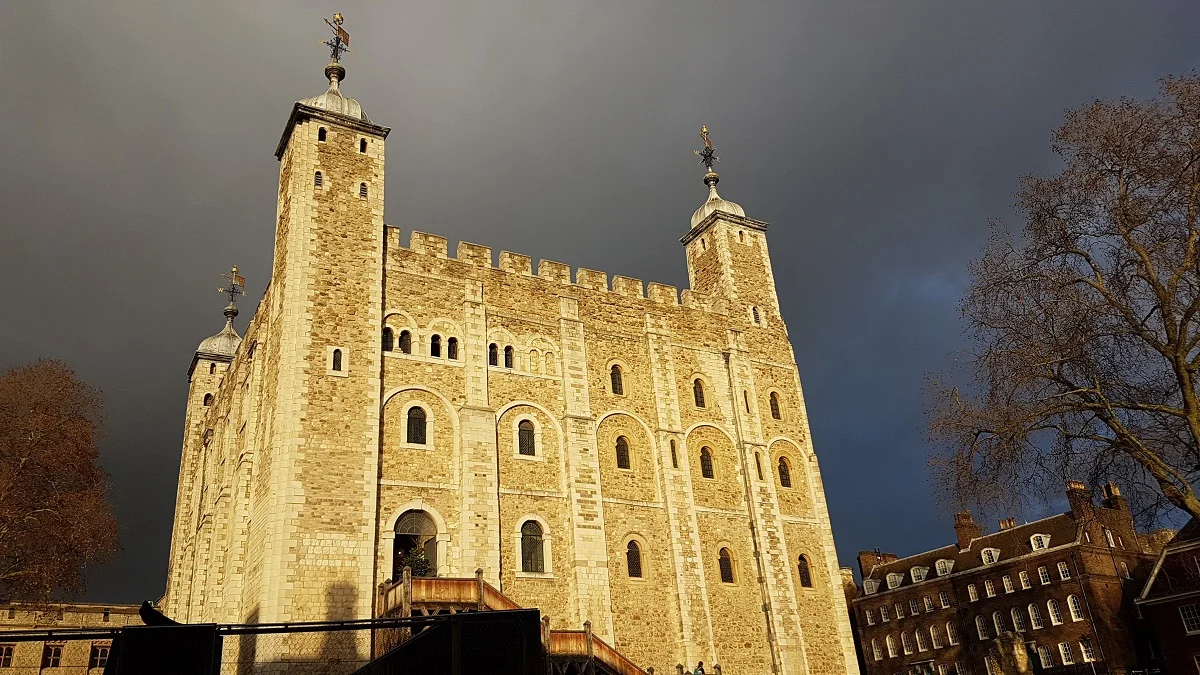
The Tower of London with a dramatic sky behind ready for a dramatic tour with kids
Pretty dramatic, eh? William had won the day, but there was still much to be done. Now he had to be accepted as King, but he was happy to just beat the English (or Anglo-Saxon’s) into submission. Which is pretty much what he did. He built castles and cathedrals in stone all over the country (visit the Tower of London!), showing his military power, and his power over the spiritual realm (remember he had fought under the Papal banner). He also invited over all his noble friends, and put them in positions of power all over the country, often getting rid of the local, English rulers. And then there was the Harrying of the North in the winter of 1069-70 (Game of Thrones stuff adults), where he put down trouble makers in the North of England (the areas including and around Yorkshire) by destroying everything - burning fields and villages, slaughtering livestock, killing people, ruining food stores and stealing anything and everything…and tens of thousands died. Brutal stuff.
And it worked. William got control of the country and things settled down. Normans and Anglo-Saxons learnt to live together, and the two cultures mixed – so for example in the English language words like beef pork, pensive and royal all come from those invading Normans.
Perhaps not so exciting, but pretty incredible when you stop and think about it, he commissioned something called the Domesday Book in 1086. This was a massive survey of ALL the land and holdings in England. Yup, that’s right, ALL OF IT, the whole country. 1000 years ago. They didn’t have cars, or excel spread sheets, or calculators, they travelled on foot, travelling by horse and wrote it all out by hand. Amazing, isn’t it? and not only is it amazing, it is also an incredible historical record – nothing like it was done again for another 800 years or so. Amazing!
And once England was secured, William headed back to Normandy, probably feeling happy in his achievements and being celebrated as one of the greatest warriors of his day. But he didn’t have a very dignified end. One day in 1087 he was riding his horse and he was thrown against the saddle, he grew sick from his injuries and died. At his funeral his stomach exploded. The priest and all the congregation ran from the church because the smell was so bad. Poor William.
And what did that mean for England? It meant his son would become king. William Rufus. And we will hear about him next time.